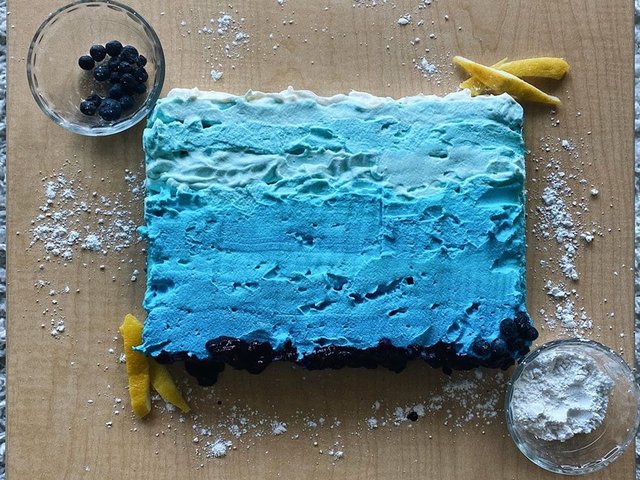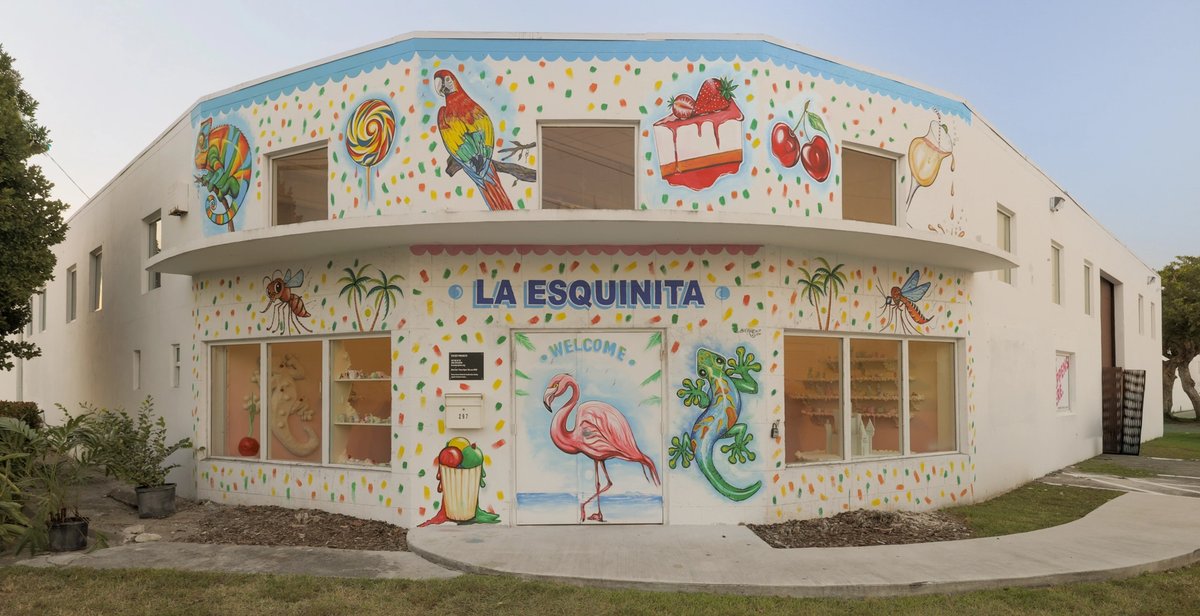
Tara Long’s new installation La Esquinita (little corner) has taken over all three spaces at Locust Projects as well as the building’s exterior, transforming the gallery into a shop for sweets and souvenirs—with more than 500 miniature sculptures for sale. The immersive environment, marking Long’s first major solo show, unfolds in three acts: seduction, exposure and collapse. Each act gestures towards cycles of extraction and survival in Long’s hometown of Miami. At the exhibition’s centre stands a crumbling frosted cake the size of a room, both a spectacle and a warning. The final room will host a pop-up speakeasy this week on Friday and Saturday nights (5 and 6 December).
In conversation, Long is unguarded, funny and precise. She speaks of sugar cravings during pregnancy, the weight of performance and growing up in a city obsessed with reinvention. Her voice is as layered as her work: part architect, part provocateur, always building something beautiful out of collapse. Long spoke about Miami, motherhood, memory and the fierce clarity that comes from making art when the stakes are so personal.
The Art Newspaper: You were raised in Miami, a city that is constantly remaking itself. What do you carry into your work?
Tara Long: I carry the absence of my mother. After she died when I was nine, I found refuge in the elementary-school art room—it felt safe in a way the rest of my life didn’t. I told people my mom was modelling overseas, and when I didn’t get into the school’s magnet programme, I borrowed a friend’s acceptance letter and said it was mine. They let me stay. Art gave me something I could hold on to.
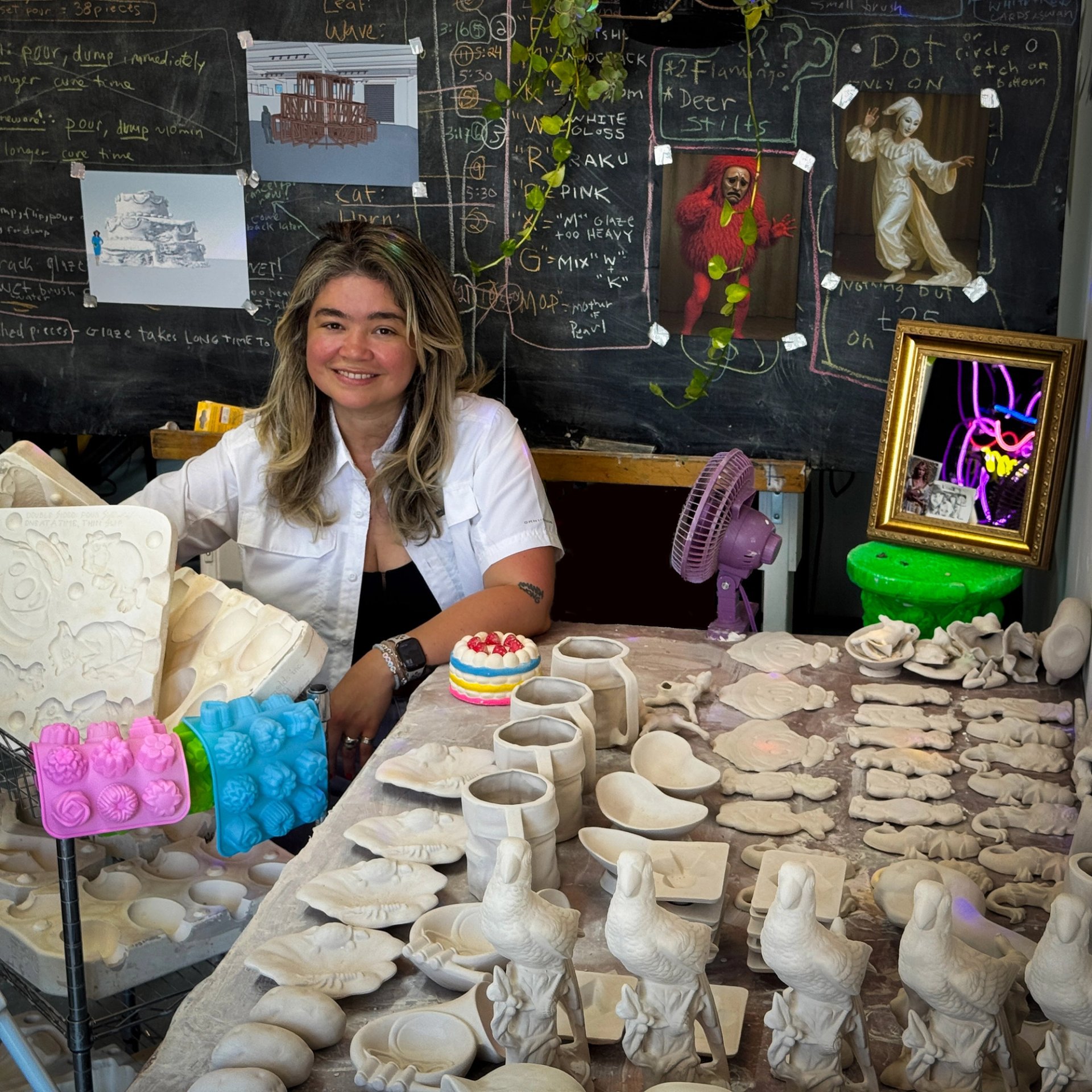
Long’s show draws parallels between the Big Sugar and Big Tech phenomena in Miami Courtesy of the artist
What drew you to a three-act structure for La Esquinita?
La Esquinita is one of those little corner spots, a bodega, which are everywhere in Miami. It became a way to talk about the city’s cycle: people arriving, nature being ripped up, others being pushed out. That structure—seduction, exposure, collapse—is the structure of Miami itself. I wanted to build a space that seduces you in the front and asks harder questions in the back.
You draw a comparison between Florida’s early 20th-century Big Sugar land grab and today’s Big Tech boom. Why did you specifically choose those two? And how do you see Miamians implicated in both?
When I started developing La Esquinita, I was thinking about the tech boom and how quickly people flooded into Miami after Covid. The project became a space for that conversation. Progress is not going to stop, but we are not powerless. How can we bring everyone to the table and move forward without repeating the roles of victim and oppressor? That’s what the last room tries to do—create an actual space where that might happen. Not in the spectacle, but somewhere quieter, facing what we’re built on.
That crumbling cake feels like spectacle, ruin and offering all at once. What does it mean to you?
Sweets became a kind of vice, something I couldn’t escape. That feeling shaped the cake. It’s personal, but also architectural. Miami’s identity is built on fantasy—some of its Art Deco mouldings even look like frosting.
In researching sugar, I learned that in ancient Greece, people offered round cakes with candles to Artemis, goddess of the moon. The candles symbolised moonlight, and their smoke carried wishes upwards. I love that—longing baked into ritual.
My Cake Hall pulls back the veil. It gestures to what locals endure, performing joy while barely surviving. It’s also a stage activated by performance, where those tensions play out in real time.
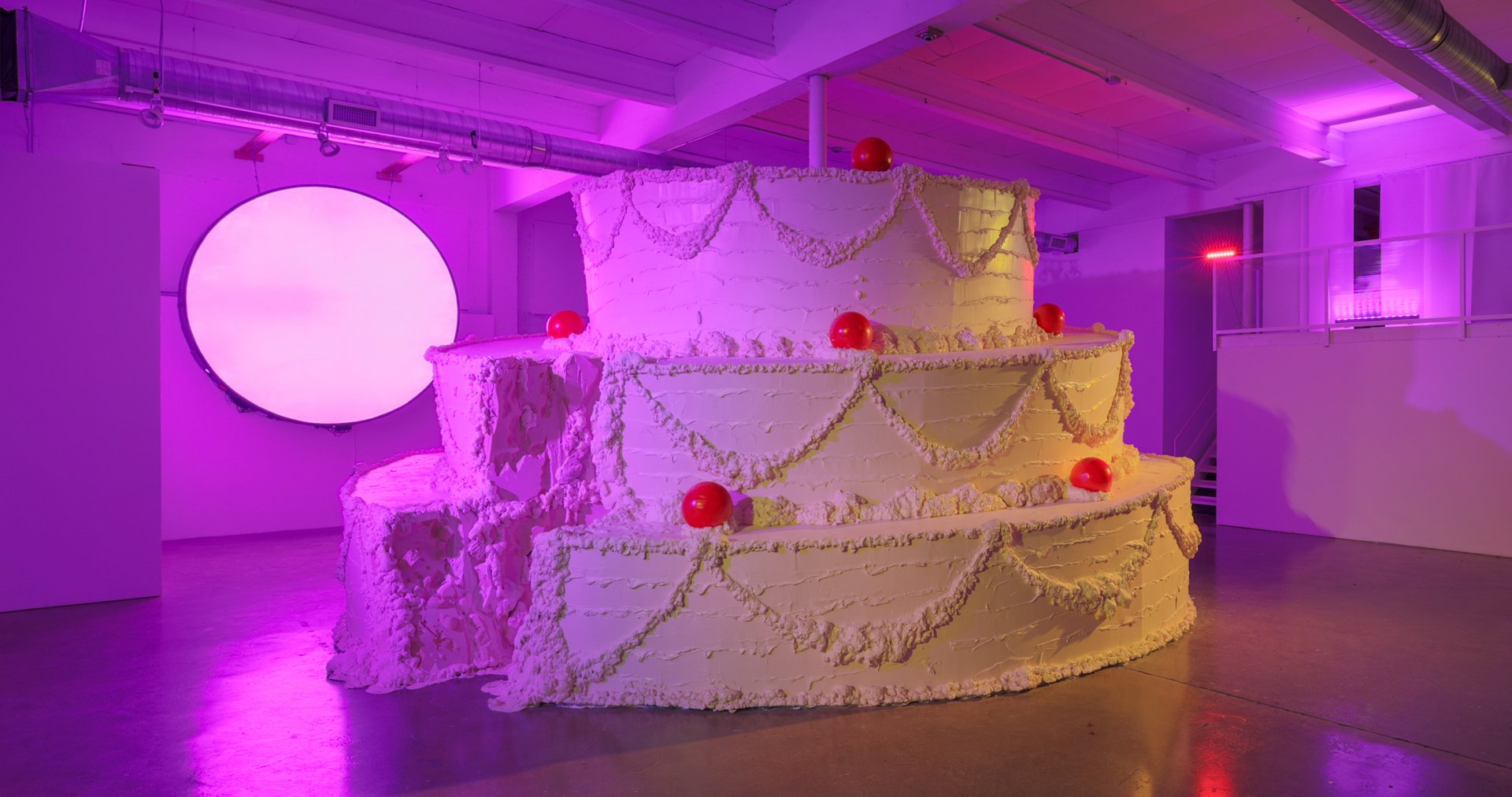
A feast for the eyes: at the centre of La Esquinita is a huge 20ft-by-12ft sculpture of a collapsing cake Courtesy of the artist
You work with materials like fondant-like plaster and cracked stucco, and you create ceramic “snacks”. How do these reflect indulgence and decay?
Sugar felt like the perfect thread—beautiful, addictive and able to rot or even kill you if you have too much. I’m using actual sugar and isomalt for the counter, walls and souvenirs, along with materials that mimic it—plaster, glaze, ceramic. I wanted to create the illusion of frosting while showing the structure beneath.
You have organised performances as part of your show using characters that fit very specific archetypes: maiden, mother, crone, anxiety, innocence, villain. How did you arrive at these?
They came through somatic movement, just letting things surface. They’re all parts of me but also shared mythologies—feminine forms we’ve all encountered or embodied. The performance is mostly nonverbal, but one word breaks through: “mom”. We did a soirée in November, and we’re doing one during Art Basel on Saturday (6 December) and a third for the closing in January.
The final space gestures towards nature reclaiming the ruins. Is that hopeful?
I wanted to give viewers a space to reflect—somewhere quiet and communal where we might actually come together. A large window projection streams live footage of the Everglades, with the sounds of nature filling the room. It’s a place where real conversations might begin—honest, unspectacular and long overdue. Conversation has to start somewhere.
This is your first major solo exhibition. Did its scale push you in unexpected ways?
Absolutely. The project came with a $15,000 grant, but it wasn’t enough. Locust gave me the whole space, so I had to figure out how to make it work. I sought out another $10,000 from a patron. If the grant didn’t cover the rest, it was coming out of my ass.
I have a small team, but no production company. I’m the production house. And I gave birth to my son the same week I got the grant, so I’m raising him and birthing this show at the same time. I bit off more than I could chew. But how could I not? You can’t make art without facing yourself. That’s the point.
• Tara Long: La Esquinita, Locust Projects, until 17 January 2026